I am a follower of the blog Playscapes and the latest blog features photos of older Japanese playgrounds. I love this image of the elephant slide:
I love the fun, creative design in these slides. Children love whimsical and I think adults do too, it helps to set the imagination free.
Check out Playcapes for more great posts on playgrounds and playscapes.
One of my favorite magazines is "The American Gardener", the magazine of the American Horticultural Society. In the November/December issue they had an article about the 2010 American Garden Award Winner.
The 2010 American Garden Award, now in its second year, featured four new flower varieties chosen by their breeders for their excellent garden performance. Once these new varieties were planted and put on display by the participating gardens, the public was invited to vote on their favorite. The winner for 2010 is Rudbeckia Denver Daisy from Brenary of America.
According the American Garden website: "'Denver Daisy' wowed voters with masses of reddish ringed golden flowers having a delicious looking chocolate brown center. It's a knockout with huge 4-6 inch golden blooms that cover attractive deep green foliage. The long-lasting golden dark eyed blooms proved their ability to stand up under extreme weather conditions. This most popular winner guarantees fantastic summer-long flower power throughout the country in gardens, mixed containers and landscapes. This variety was created and named in honor of Denver's 150th anniversary."
Second place is Echinacea 'Prarie Splendor' from Syngenta Flowers with it's three inch amethyst blooms and long blooming period from early summer to late fall.
Both of these selections will be very well in our climate and will be well appreciated by bees and other insects.
The third place winner, an annual, is the ornamental pepper 'Purple Flash' from PanAmerican Seed.
This will look fantastic in a container, adding great color and interest, it would also look great surrounding a pot of Rudbeckia 'Denver Daisy'. Now that's a fun combo.
I'm getting excited about spring and the upcoming season, I can't wait to plant these this year!
I went to go visit a client and her landscape yesterday to make sure everything was overwintering well and it all looked great, including the crocus bulbs coming up.
What?!?
It is early February and in Central Oregon that is too early for even the early bulbs to be coming up. Even though it is really a lovely bright spot in her garden, she was concerned that she wouldn't have the beauty of the bulbs for later in the season.
For the bulbs that have already flowered or are budding, there is nothing to be done. There actually is not much to be done at all when unseasonally warm weather prompts bulbs to grow or trees to start budding out earlier than normal. The bulbs that have not budded should slow down with the return of the cold temperatures. Putting down some extra mulch to eliminate any light that the bulbs are getting might also slow their current growth down.
Meanwhile, enjoy those little spots of color and start thinking, planning and dreaming of this years gardening season!
Horticulture magazine just posted an article on their website highlighting Ilex verticillata 'Sparkleberry', a lovely addition to brighten up the winter landscape or to bring branches indoors for decoration. This prompted me to do a little more research since I am familiar with the evergreen hollies for our area but haven't delved into the deciduous varieties as much. Since 'Sparkleberry' is a deciduous shrub, the red berries that persist through the winter really stand out adding a lovely red sparkle to the landscape.
There is disagreement as to which zone it grows best in. I've seen it listed as growing in zones 3 - 8 but most of the listings show it as zones 5 - 9. It is widely adaptable to varying soil conditions but since it is an Asian cross it prefers more moisture. For best fruiting plant it in full sun and since this is a female variety, it needs to be paired with a male for pollination. Ilex 'Apollo' has been bred to be used as the best male pollinator but other male hollies will work as well.
Sparkleberry may get up to 8 feet tall (it's listed as 12 but that is "valley speak", plants in Central Oregon never grow as big as listed on the tags) and wide and is a nice dark green turning yellow in autumn.
As with most hollies, the berries are a great food source for birds and will bring in a large variety of birds to feed on the shrub. Another delightful addition to the landscape!
Ahhh, January. The month for skiing, relaxing and reflecting. The holidays are over, the garden has been long wrapped up and it's still too early to do any real gardening.
At least that's what you think.
This is actually a time to be busy thinking about how your garden and landscape performed this past year and to make plans for this upcoming season. Did your landscape provide you with good Spring, Summer and Fall interest? Is it interesting in it's Winter state right now? Do you want more color, texture, height or shade? These are all great questions to think about and to help you create a more appealing landscape that you really want to spend time in.
Right now when you can see the true "bones" or structure of your landscape, is a great time to consider what you might need to add, adjust or build in order to have an appealing Winter landscape. Some of my favorites are personal art pieces be they sculptures or found junk. These items add a real nice touch and a sense of "terroir" (sense of place) to individualize your garden and make it a true extension of your home.
At Garden Fun they have a whimsical collection of garden art, stakes, bird feeders and more. They have a lovely blue/green peacock sculpture that would really liven up any landscape. Their site wouldn't let me copy the image so go here to see it.
Here are some other examples of fun and beautiful art for the landscape:
Finally, don't limit yourself to 3D items, use the walls of your home to display art. This image is from Inside Out Garden Art in the UK. I love how this piece of art creates a room in this garden:
These are the kinds of things I think about in the winter as well as the plants that really help make a winter landscape more interesting.
One of my all time favorite trees is the Mountain Ash. I love the white umbrel shape of the flowers in the spring, the dense canopy for summer shade, the orange, red blend of autumn foliage, and the red berries that persist into the winter adding natural holiday ornaments to the landscape.
Along Simpson avenue here in Bend, between Columbia and Colorado, are stands of Mountain Ash trees. They don't all still have their berries, usually the berries are perfectly ripe and soft by now and the birds swarm in to get a little winter fat. I remember a couple of winters ago, we had a white Christmas and the Mountain Ash outside my dining room windows was full of red berries. About mid January, for about two weeks, the tree was full of birds gorging themselves on the berries. It added so much beauty and interest to my winter landscape that I try to put a Mountain Ash in every landscape if it is appropriate. You can also get them in shrub form. And guess what? They are native to Oregon!
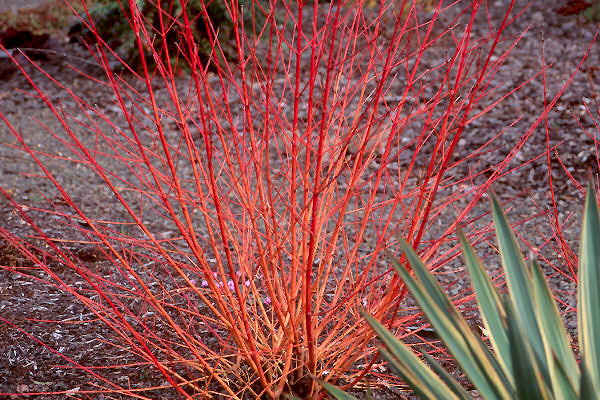
There is also the favorite Red Twig Dogwood which provides the nice red branches to use for holiday decorations or outdoor viewing pleasure. There is also the Yellow Twig, Mid Winter Fire and Arctic Fire which offer different colored branches. Remember that the new branches are what provide the good coloring so you need to prune back the oldest canes in Spring.
Red Twig Dogwood:
Yellow Twig Dogwood:
Mid Winter Fire Dogwood:
There there are also the trusty evergreens in tree or shrub form:
Hoopsii Blue Spruce:
Weeping Blue Atlas Cedar"
Golden Korean Fir:
The naturally sculptural Manzanita:
Blue Star Juniper:
Procumbens Blue Spruce:
Pinus strobus 'Niagara Falls', a new introduction by Iseli Nursery out in Boring Oregon and was selected as the Collector's Conifer of the Year in 2009. A very interesting variety of the Cascading White Pine:
Gold Strike Juniper, also a new introduction from Iseli Nursery. The brilliant yellow needles take on coral tones later in the year. What a great little landscape brightener!
If you have any questions about what plants might be most appropriate for your landscape or would like me to take a look to improve your winter landscape, please contact me at tanya@carlsengdesigns.com.
Tuesday the 7th is my turn to host the monthly Wine and Designs for the local High Desert Design Council. This is a group of interior designers, landscape designers, architects, builders and vendors dedicated to bringing sustainable design to the Central Oregon area.
This month we will be meeting at the residence I created the landscape design for two years ago. It was a fantastic design combining the front and side yards of two properties, blurring the lines between "theirs" and "mine". The landscape is also grass free, mulch free, deer resistant, filled with seasonal interest, water wise, low maintenance and wildlife friendly.
I will be highlighting this particular landscape but also talking about the different services Carlseng Design offers (consultations, conceptual and to-scale designs and gardening services) and presenting a slide show of some of the other local landscapes I have designed.
If you are local, please join us at 1524 NW Kingston in Bend. I'll be posting some photos of the event to share with you.
As always, any questions you have about gardening drop me a line! Take care.
A couple of weeks ago a client called me up to help her plant some annuals she had gotten but hadn't been able to plant because she had gotten sick. She lives on a five acre beautiful property in the vicinity of a red tail hawk nest and the pair would present themselves every afternoon.
She had a few flats of lovely annuals and basically let me get on with planting them into the containers on her deck. I love putting together little vignettes of color! And since I had seven or eight containers I could really get into doing a "variety on a theme". How fun!
Next she explained that she wanted her front bed to be full of color, gave me a budget (a budget is very important for people like me as I enjoy nothing more than buying plants with other people's money...) and off I went to the nursery to select the best plants for her location. When I got back and had everything planted in a subtle and attractive pattern, I couldn't help thinking that I am extremely lucky in my choice of profession. I got paid to plant flowers!
But of course it isn't that simple. I did repair and modify some irrigation and mulched the flower beds as well which created a lovely mix of technical work, manual labor and garden design. I call that a great day of work.
Yesterday I got to go back up to another beautiful property near Sisters to help put the finishing touches on a garden that will be on the Sisters Garden Tour the 8th of July. These clients have maintained a lot of the natural landscape and have worked hard to create an organic landscape that does not deter from the natural beauty of the area. Their home is straw bale, full of soft corners and big windowsills and is embued with a sense of peace and beauty. They thank me for coming to work and I thank them for having me there, I love being at their property.
I had been there earlier in the season to get things under control (mainly weeding) but also some irrigation work as well. They had two big overhead sprays to water the edible fenced garden and it was quite inefficient. I converted it to a drip/microspray system and then mulched the beds. Those two things will go a long way to combating weeds and lowering water usage.
But going back yesterday and seeing the garden areas bursting with flowers and seeing the work I had done previously was extremely satisfying.
Born again gardener. I started gardening professionally in college but thought I needed a "real job". It took me years, but now I'm back and loving every minute of it. I have a great balance of quiet working time at my table and time outside talking with clients and walking landscapes.